
Recruiting In 3D

In Plain English: How To Talk To Tech Candidates

For many recruiters, particularly those hunting in-demand technical candidates, talking tech can be one of the most daunting and intimidating parts of their job. And when you need to assess whether or not your candidate can do the job, this becomes an integral part of doing your job well.

Having spent the better part of 15 years doing technical recruiting, I had to climb this mountain as well to get to the level of comfort that I have today. I still have to go back to the well and gather more info when new technology emerges, but that’s not going to change anytime soon.

Here are a few ways to get more comfortable in a world that many of us did not go to school for.

Know Your Tech Stack

If you’re struggling to understand the difference between front end and back end or HTTP calls and responses, then you need to do some homework. Nothing is worse than being the recruiter who calls a Java engineer about a JavaScript role, you know, because they both say Java.

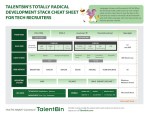
TalentBin has a great beginner reference that breaks down the variations on a tech stack, which you can find here. You may still need to do some digging in order to then understand what each tool or platform does, but this gets you a head start in the right directiontalentbin cheat sheet
You may also find times when you need to just know what the heck something is. There are a few that I’ve used in the past, which still aid me to this day. Bookmark them, and keep them handy for when you need them.

http://whatis.techtarget.com/ 

http://www.webopedia.com/

Spend Time With Engineers

One of the most resourceful ways to get info is to ask questions of the people already doing this work at your company, the engineers themselves. I’ve spent many hours talking with engineers at the companies I’ve worked with to understand what they do, how different technologies work with each other, and exactly what the point of those technologies are. Humans by nature love to have their ego stroked, and people love talking about what they are passionate about.

This is your opportunity to ask the questions you need to about the technology and the day to day work that you don’t get to see every day. As always, you never get any questions answered if you don’t ask them.

Research StackOverflow & GitHub Profiles

A good proportion of tech candidates spend time curating their Github and Stack profiles, just as we do with LinkedIn, and other sites for our social footprint. Simply perusing what questions they have answered, their reputation and the technology that they use most often.

Not only will this give you a sense of their background and expertise, but it can provide you with talking points that will engage the candidate. And, what’s more, is that they may even be answering questions that are relevant to the position you are hiring for, which gives them some credibility.

Admit What You Don’t Know

Simply put: Don’t fake it and give an answer for the sake of giving an answer. If you don’t have an answer for the candidate on a tech question that they have for you, it’s OK to say you don’t know and need to get back to them on it. (If you say, that, follow through and get the answer – again, credibility is a two-way street. Your candidates will appreciate your candor, and the engineering teams you work with will value your desire and diligence in understanding the work they do, which too many people often take for granted.

Happy Hunting!
 

The Emperor’s New Clothes: Lookup and the LinkedIn Talent Disconnect

Love it or hate it, LinkedIn is one of those companies that’s constantly tweaking their platform; that they put a ton more time and money back into their actual product than most HR Technology vendors, and make much more substantial updates to core features and functionalities than most online and SaaS companies, period.tumblr_mahxbaNXm91qc7mh1

The average active LinkedIn member (note: the “average” LinkedIn member, in fact, isn’t active on the website) a recent study suggested only around 37% log on at least once a month) spends a scant 17 minutes on the site every month, compared to over the over 20 minutes a day Facebook’s 1.3 billion users spend on site.

The average recruiter, by contrast, more or less lives on LinkedIn, which is why we’re so quick to catch even the most minor tweaks to functionality or the most subtle changes to the site’s UI/UX. Recruiters know LinkedIn better than anyone, which is why no one in this industry would deny the sheer level of work that goes into iterating current functionalities, introducing new features and experimenting with potential enhancements or revenue streams (remember CardMunch or Connected, anyone?).

This is why so many of us are so frustrated at the fact that what was once such an effective, disruptive and innovative recruiting technology has devolved into whatever the hell LinkedIn has become these days – although frankly, I’m not even sure the company itself knows what LinkedIn is supposed to be, anymore. While the amount of work that goes into the product is self-evident, exactly what the hell the point, or value, of this work actually is to its end users and customers, however, is another story entirely. Read More

Stop It. You’re Not Jumping Off The LinkedIn Train

I think it’s relatively safe for me to say that I’m less the raging fanboy of LinkedIn that I was in my earlier career. No, really, I’ve been pretty vocal about it. So when I’m coming out in quasi-defense of LinkedIn, that’s a little surprising, even to me. Anecdotally speaking, there is a large population of recruiters who are shouting from the rooftops ‘Down with LinkedIn!’ and ‘Who uses LinkedIn anymore!?’. Maybe they have had enough of the ever-original memes and dynamic inspirational quotes on the Pulse publishing platform. While they are certainly entitled to their opinion, to them I emphatically say, “B*itch please”.AAEAAQAAAAAAAALXAAAAJDlkOGRiZjc0LTZkOTktNDkzMy04OWQ2LTMzOTZkNmZjMzJiMw

Read More

TMA’s Social Recruiting Summit Recap

Last week I attended the TMA Social Recruiting Summit in New York City. For a kid from New York, any trip there is nice, because in addition to being able to see some family while I am up there, I pretty much eat pizza every day and twice if I can find an excuse. Being able to cover the event gave me the ability to view the conference from a different perspective, where I could actually listen to all thecontent, while also taking in how the crowd is reacting to it.

The event itself was well attended by about 125 people, and it was nice to see that the attendees’ experience levels and industries varied greatly. This was particularly refreshing, because it brought out some of the challenges that are definitely unique to certain industries, while other times attendees were secure in knowing everyone else faces the same struggles. TMA did a really nice job on including speakers and content that spanned recruiting, sourcing, marketing and employee branding. It’s a tough feat to successfully cater to an array of audiences in a smaller conference, and it worked. Read More

Workshop Recap: Build Your Agency’s Talent Pipeline

I had the opportunity to attend a workshop last week, sponsored by DiceTMP DiceGovernment and the Partnership for Public Service, which centered on how to effectively build talent pipelines for your agency. Much of the content was centric to the federal sector, but as always it contained some relevant information for public and private alike. In addition to a lineup of well-informed speakers, they also included a panel of young professionals that helped drive home the message of the day: Recruiting needs to keep evolving. Read More