Recruiting In 3D

Found Your Ideal Candidate? Good. Make a Good Offer.

One thing I never understand is why companies have a habit of making low-ball offers. As recruiters, we go through painstaking processes in order to source, attract, screen and move candidates through the hiring process. In many cases, a full write up is sent to hiring managers (or other KDM’s) and the vetting begins.

So why is it with so many apparent QC checks in place, that companies still tend to make offers that are clearly so far below candidate expectations? I know that the market is bad, and the sky is falling – this too shall pass – but that doesn’t mean we should not be planning for the future, with the hires we make in the present.

I said to Jessica Lee the other day, when she was pondering taking the SPHR exam, that the more bullets you have in your gun (i.e. the more training and depth you have) the longer you stay in the gunfight. Couldn’t then, the same be said for making an offer to a candidate that is compelling and fiscally savvy? If you know what the candidate makes and have spent the time making a a point to know what they want, and you know what the budget can handle, why would you then not make your most compelling offer up front, getting the candidate to accept quickly, and instilling an immediate sense of excitement that this is the right opportunity for them. You may also be DRASTICALLY reducing the rate of counteroffers as well, since if they feel wanted and satiated in their comp needs, then they may be less likely to even consider a counter offer.

Know the facts up front, hit the offer head-on, and make your organization one that is not pigeon-holed into being “one of those “low-ball” shops. Candidates will appreciate the candor, hiring managers will love knowing that you can close the deal, and they can get their 1st choice candidate.


Bookmark and Share

How not to do a job fair – Yes, YOU.

Ok, so after the last of the fall job fairs ended today, I really had to just take a deep breath. And, finish that last drink of beer here in the airport (What, a guy can’t imbibe after a long day of repeating the same phrase 647,…no, 648 times? I also decided to craft a list, a dummy-proof list of things to do AND not to do/say/spew at a job fair. Yes, I’m an equal opportunity whiner.

DO:
1. Have your resume with you. Nothing is more frustrating than trying to picture your resume in my mind’s eye like before the first time I went to Disney and pictured Space Mountain.
2. Research us a bit. Give me 1 sentence that tells me you have internet access and had the sense to show some (even feigning) interest in us.
3. Dress the part. It’s not an interview, but remember, I’m half-deciding if you are someone I want to interview.
4. Have a smile, and a story about who you are, and why you are a person I want to know. Half of all communication is non-verbal, and a smile says, “HI! How are you today?”
5. Know what you are looking for. Telling me that you majored in Marketing because you like marketing, or IT because you want to work with computers is redundant.

Do NOT
1. Invade my personal space. I can hear you from 12 inches away. (Caveat – DO talk loud enough for me to hear you from 12 inches away.
2. Recite a pre-rehearsed speech that tells me about every project, skill, tool, building you ever worked in or on. That’s why you have a resume. All this tells me is that you have no ability to quickly and concisely disseminate information to another person.
3. Be combative when I tell you that Astrophysical Material Science is related to our business, and I am wrong. Remember, I am the keeper of the keys/resumes. (wow twice in one week I pulled Astrophysic-somethin, BONUS POINTS)
4. Ask what our company does. Check the Interwebs.
5. Have a resume that looks like my 14 month old wrote it. Really? REALLY? This applies 100-fold if you are a PhD candidate, unless that is something you’ll learn at the dissertation stage.
6. Go off on a 10 minute diatribe about how I MUST be wrong about immigration and that you are eligible. I play by the rules set by the lawyers, not make ‘em. I could have lied to you, but I gave you the straight story on why.

Job fairs suck. We all know this. On our side of the table, we stand for 5-7 hours, repeat the same message, and collect all sorts of germs. On your end, it sucks to be herded like sheep at a pageant. But we can make it easier on both of us by doing things the right way.

Stay tuned for a recruiter’s version of the “million man” promise to candidates.


Bookmark and Share

Why that interview DIDN’T get you a second date.

I’m always concerned about making first impressions, whether it is in my personal life or professional settings. They say you get one shot at it, and you’d better make it count. Recently a few situations have come to light that really make me wonder if first impressions are a lost art.

When you think about it, going for a job interview is a lot like going on a date. You may have been introduced to or made aware of one another by a mutual acquaintance. Additionally, with all of the tools we’ve got available to us these days, the likelihood is increasing that the connection was made blindly on a website – be it Monster or AshleyMadison.com (I’ll leave finding out what the heck the latter is to all you Howard Stern fans.

Think of all the things you do when preparing to go on a first date – you (hopefully) shower, shave, potentially buy new clothes, etc. Nowadays, it’s also likely probable that you use Google, Facebook, MySpace or some other form of research on your date prior to going out. Let’s be real, it’s a kooky world out there, and people want to know if they are going for Sake at Nobu with the next Ted Bundy. People will go to great lengths to find out as much as they possibly can on the other party before going on these dates.

What is AMAZING to me then, is that a vast majority of these folks do none of this before interviewing for a job! Sure, dating someone could lead to some life-changing events, but are any of them likely going to be as impactful as the next job that can change the entire scope and direction of your life. True story, about 3 months ago, I spoke with a candidate over the phone, who was referred blindly to me by a former colleague who knew his skill set would be perfect for our company. (It was spot on, and my recruiter “Giggity Meter” immediately went off the charts.) I pretty much dropped off whatever wasn’t an offer for the next few minutes so I could schedule time to talk to this candidate. I knew going into this that all the standard needs for us were there: deep knowledge of and visible footprint in the industry, pedigree school, all the right contacts, and innovations we would look for. Right now you are thinking, “whoa…perfect slam-dunk hire”, right? WRONG. We set up time to talk later that week, since I’m big on having people’s undivided attention when trying to change their life, and can’t expect they are always ready to take my call. Here’s where it all went wrong:

About 20 minutes into the conversation after all the normal who/what/when/where/why’s were exchanged, things went awry.

Me:So how familiar are you with us (company name not disclosed, as always)?
Candidate: Not at all actually. You guys are one of those companies that puts mailers in the newspaper right?

    (This is about as far off as me being a Harvard-Trained Astrophysicist with a post-grad degree in Swahili)

Me: Pardon?
Candidate: Yeah, you know, insert mailers.
Me: Actually, no…………(deep, deep breath). We actually do Market Research for the Web (I went on in more detail, yadda yadda).
Candidate: Oh how about that. Well, I guess I could be interested in that too.
Me: Have you seen our website, or any other material out there, like out Facebook, Twitter, or YouTube pages?
Candidate: No, plus I think the Twitter thing, I’m not on it. Frankly, I don’t know if it’ll last.

This was really where I knew things went downhill. I work for an incredibly progressive web company, and if you aren’t in tune with the web, why would you passionate about working here? But the thing that got me most, was the complete lack of any research at all. I would have completely given a pass if it was a “cold call” and the candidate had no time to prepare. The person had an EMAIL from me, stating the day and time we were talking, and the role I wanted to discuss. But, instead I was so turned off by the utter lack of preparation and disinterest shown, that I politely ended the call and said we’d be in touch if anything came to light matching the background. After having ended the call, I realized that it may have been beneficial to the candidate to mention doing some prep work in the future, but there is just no helping some people. I suppose I would have been more inclined to do this if it were a recent grad, as opposed to a 7-10 year vet who should have known better in my book.

In the end, with all of the tools available to candidates to do all sorts of extensive research on a company – down to where the hiring manager graduated from and what they majored in – why are people seemingly doing LESS research now. We’ve got LinkedIn, Google, Facebook Pages, Twitter, Plaxo, and I could go on, but too many people do a quick scan through the mission statement and benefits pages without really researching things that help them to stand out from the crowd. If a candidate was able to tell me about the two newest products we released to the market, or the new acquisition a company has made in our industry, or a new promotion from a press release, that would impress me.

My point is, people do more research for a cheap steak and margarita than they do for a potential six-figure job. You can do endless things to make yourself a more appealing mate, why not apply that to your career?

Don't be THAT guy

Don't be THAT guy


Bookmark and Share

Keeping The Ambulance Chasers Away When Recruiting With Social Media

It’s coming. As sure as the sun will rise tomorrow, it is coming. The US has become an incredibly litigious society in the last 20 years or so. Remember the lady who sue McDonald’s because the coffee she bought was hot, and burned her? And about 100 other similar cases over time? Well folks, soon they will be attacking recruitment practices on social media (SM) sites. Mark my words.

As Jessica Lee highlighted this in her most recent Fistful of Talent post, there are concerns that lawsuits may rise because of the rise in recruiting on social media sites, such as Facebook, Twitter, and MySpace.

Now I’ve been saying for sometime, that we’re just in the waiting period before the first company gets hit with a discrimination suit after recruiting on a SM site. Not because it is an inherently bad practice, but because it is a wide open target. From my perspective, I’m a bit leery of actively recruiting off of SM sites, not because I think it’s bad, but more because I don’t want to be the first to get hit. Our team uses a more passive approach on these sites, to divulge information about the company and it’s openings, and to formulate more of a circular recruiting approach to drive traffic back to our company site. In this way, we’re using the site for a recruitment purpose, but not necessarily sourcing off of there, per se. I recently hired someone off of Twitter (our 1st off of there), but it was someone who reached out to us, after seeing some tweets we put out there, and having viewed our career site, hence circular recruitment.

But as Jessica puts it, and as I’ve seen it in other posts out there, SM CANNOT be your only method of recruitment. Sure, if you are seeking people with SM backgrounds or certain creative skill sets, these might be a strong source for you, but hopefully you are supplementing this with other sources. You’ve got to cast a wide net to source and identify the best of the best out there, and one or two sites won’t get you there.

The ambulance chasers will always find something to file a suit against, and people will always look for a way to get rich quick at someone else’s expense. But a well thought out, and well rounded approach to your recruiting will hopefully guard you from any frivolous accusations. You should be taking an active look at your process, and evaluate where you might have any risk exposure.

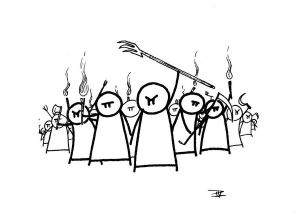
Plan accordingly, avoid the mob.

Plan accordingly, avoid the mob.


Bookmark and Share

Are You Rolling The Dice With College Recruiting?

This is probably the ideal location for me to go on some rant about how great “The Hangover” was this summer, but I’ll do my best to refrain – no guarantees. What I really want to touch on is how your college recruiting program can look a lot like the tables in Vegas. I’m inclined to write about this because: A. I just came back from a trip to Sin City in the last few weeks, where I surprisingly did a minute amount of gambling and B. College Recruiting has begun anew for the 09-10 school year. So, bonus points for me and my circular relevancy.

Vegas Baby! or Maybe State U!

Vegas Baby! or Maybe State U!

So here’s how a great deal of college recruiting goes: Company signs up for fair. Company goes to fair, yaks up company, collects resumes. Company holds PowerPoint slide show, branding extravaganza (Also known as Information Session).Company parses through resumes, and selects on-campus interviews. Company selects 2nd round (maybe 3rd round, as well) interviews. Company makes offer, student accepts (some decline). Company hires candidate.

What has the company gotten? Well, potentially a dud. Maybe someone who does not work out, who perhaps interviewed well. But potentially they get a rock star, a motivated, and successful hire. Hopefully more of the latter, but all of those people have a common trait. They came to the company – all of them. Not Vice Versa. So I liken this to gambling because you aren’t you really playing the odds every time you go through the process like this? Wouldn’t you be better served going after more students aggressively? Certainly, there is still going to be a cross-section of candidates who came to you, but why not reduce the need for relying on chance?

Equate this to another scenario: Plan and pay for Vegas trip. Get to Vegas, yak up dealers, friends, and anyone willing to listen. Spend money to play cards, dice or vice of choice. Spend more money if you lose. Potentially come home with a bit more cash or much less than you went with. Same Same.

There are many things that a company can do in order to make their brand better known, and to reach students before they even hit a job fair, and to be on the top of their mind.

  • Career Services gets a bad rap as a place where you don’t get much accomplished in trying to get connected to academia, or getting directly to students. And really, that’s not the primary function of their job at all universities. But if they are used correctly, as more of a conduit, than the end game. They can provide you with information about student groups, and groups, clubs or societies that are part of a major/school. They can provide information for you, and generally are happy to do so, if you are not walking in there and asking for a list of students that “are looking for jobs”.
  • You can contact many of the groups etc. and find out when they have events that you can sponsor. This might be a dinner, or awards event, or even guest speaker. These students are happy to help. The money they may or may not get donated helps. But hey, this is college recruiting, and it takes money to make money, right? They are also going to help you with finding out about small-scale fairs for students in their disciplines. These typically have fewer, but more targeted attendees.
  • You must kill the information session. In fact, it’s already dead, so you’ve saved time. Whatever is going to be provided in the “branding extravaganza” they can get in 15 minutes online, and…they like it that way. In this regard, faculty can be helpful. They want to get exposure for their students. Their students getting jobs is good business for them. But you’ve got to have something compelling to go in with that isn’t a “Rah-Rah” speech. If you can get candidates interested in your industry, you can get them interested in you. Remember that, and you’ll have some interesting stuff to deliver to them.
  • Finally, and most importantly, you have to stick to what you say you’ll do. There’s a big reason most students are mistrusting of the current process as it stands – many in our profession don’t keep their word. When we say that we want to stay in touch with them through the year (maybe they are a junior who already has an internship, or a sophomore we cannot use just yet) we need to do so. When we say that we’ll be contacting candidates back in 2-3 weeks, we need to do so. Or at the very least, let them know that you’ll be contacting back students who were selected, by “x” date. At least they know, that if “x” date comes and there is no word from you, then they have their answer.

Now, I will say that there are exceptions to these rules – we all know that there are certain……let’s call them Big Boys, who can just show up, and people will flock, they have all the connections they need at the school to get the best 5-10 candidates from each discipline (again, money helps A LOT with these issues). And they can just play the same old notes and get what they need, what with all their cool t-shirts and all (They actually are quite witty, to be frank). But let’s face it, we’re not all companies the size of a 3rd world country, and aren’t all afforded that luxury.

So, are you going to be the active hunter, trying to seek out the people you want at your company, or do you want to roll the dice, and see if your number eventually comes up?

PS – I couldn’t resist. The Hangover WAS a great movie. I’m sure many a bachelor party was scratched due to it’s release, and many a reminiscent moment was had around the country. Go see it, or get it on that Netflix queue.

Don't build relationships and networks, and it's all a gamble.

Don't build relationships and networks, and it's all a gamble.


Bookmark and Share